OTC vs Prescription Hearing Aids: Pros, Cons & Who They’re For
If you have started looking into hearing aids, you have probably run into the same basic question a lot of people ask at the beginning: should you buy an over-the-counter device yourself, or should you work with an audiologist for professionally fit hearing aids?
It is a fair question. OTC hearing aids have made hearing care more accessible for many adults, and for the right person, they can be a reasonable first step. But easier access does not mean they are the right solution for everyone. The FDA’s OTC category is specifically intended for adults 18 and older with perceived mild to moderate hearing loss.
The real issue is not just where you buy the device. It is whether the device actually matches your hearing needs, your day-to-day listening demands, and your long-term goals. A hearing aid that works reasonably well for one person can be frustrating, uncomfortable, or ineffective for someone else.
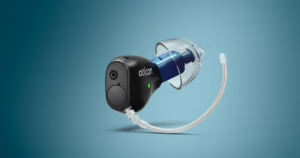
In this guide, we will break down the difference between OTC and prescription hearing aids, the pros and cons of each, and who each option is really for. We will also look at something that matters a lot more than most people realize: the fitting process itself. At Listen Hear Diagnostics, that includes advanced tools like real-ear measurement and the newly added Otoscan 3D ear scanning system, which helps create a more precise digital model of the ear for custom products and can improve fit accuracy from the start. Natus describes Otoscan as a 3D digital ear scanning solution designed to support more efficient, precise, and personalized care, and says digital scanning can improve fit accuracy while reducing remakes.
What are OTC hearing aids?
OTC hearing aids are hearing devices that adults can buy directly without first seeing a hearing professional for testing, fitting, or programming. They are designed for adults age 18 and older who believe they have mild to moderate hearing loss.
That point matters. OTC hearing aids are not meant for every type of hearing problem. They are built for a fairly specific group of people, usually adults who notice they have trouble hearing conversations, television, phone calls, or speech in some environments, but who do not have more severe or medically complicated hearing concerns.
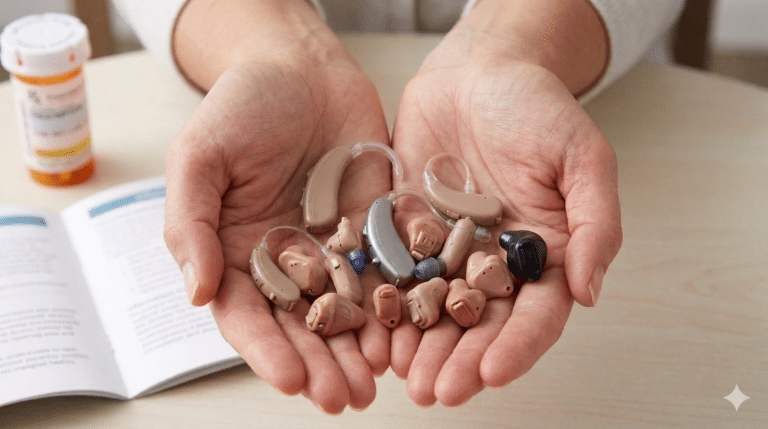
Most OTC hearing aids are sold online, in stores, or through major retailers. Many are self-fit devices, which means you use an app, online instructions, or built-in presets to adjust the sound yourself.
The appeal is obvious. OTC hearing aids are easier to access, they usually cost less up front, and they can feel like a lower-pressure way to get started.
For some people, that convenience is a real advantage.
What are prescription hearing aids?
When people say “prescription hearing aids,” they are usually talking about hearing aids that are selected, programmed, and fit by an audiologist or hearing professional based on a proper evaluation.
That process is a big part of the difference.
With professionally fit hearing aids, you are not just buying a device off a shelf. You are getting a hearing assessment, guidance on which technology level and style make sense for your needs, programming tailored to your hearing loss, and follow-up care to fine-tune the results. Listen Hear Diagnostics specifically emphasizes comprehensive hearing evaluations, hearing aid evaluations, personalized fittings, and ongoing follow-up care as part of that process.
At Listen Hear Diagnostics, that level of care matters. The goal is not simply to make sound louder. It is to help patients hear more clearly and comfortably in the real situations that matter most, whether that is one-on-one conversation, group settings, work meetings, restaurants, family gatherings, or phone calls.
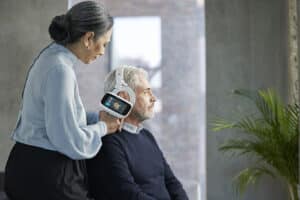
That is also where newer fitting technology can make a difference. For patients who need custom earmolds or other custom in-ear solutions, Otoscan allows Dr. Emily Esca to capture a detailed 3D digital scan of the ear rather than relying only on a traditional physical impression. In practical terms, that can make the process cleaner, more streamlined, and more accurate, with a digital file that can be sent directly for manufacturing. Natus says the system is designed to streamline production, improve fit accuracy, and reduce remake rates.
Professionally fit hearing aids also make more sense when hearing loss is more significant, more complex, or simply harder to manage without expert help.
What is the biggest difference between OTC and prescription hearing aids?
The simplest way to think about it is this:
OTC hearing aids are self-directed. Professionally fit hearing aids are guided care.
With OTC devices, you are mostly on your own. You choose the device, decide whether it seems right for you, fit it yourself, adjust it yourself, and troubleshoot it yourself.
With prescription hearing aids, the process starts with understanding your hearing and then matching the treatment to that reality.
That difference sounds simple, but in practice it can be significant.
Two people can both say, “I have trouble hearing,” while needing very different solutions. One may have mild age-related hearing loss and do reasonably well with a self-fit device. Another may have uneven hearing between ears, more severe loss in certain pitches, speech clarity issues, tinnitus, or a medical concern that really should not be handled with a retail purchase and guesswork.
The device matters. The fitting, verification, and support matter too.
And fit is not just about comfort. It affects retention, acoustics, feedback control, and whether a patient actually keeps the hearing aids in. That is one reason the process behind the device matters so much. When a clinic can combine careful testing, hearing aid selection, digital ear scanning for custom components when appropriate, and real-ear verification, the result is a more personalized and precise fitting experience than what most self-fit pathways can offer. Listen Hear Diagnostics highlights real-ear measurement as a core part of verifying that devices match a patient’s hearing loss, ear anatomy, and physical fit.
What are the pros of OTC hearing aids?
OTC hearing aids do have real advantages, and it would be dishonest to pretend otherwise.
They are easier to buy
This is the obvious one. You do not need to schedule an appointment, wait for a fitting, or go through a full care process before trying them.
They usually cost less upfront
For people who are hesitant about hearing aids or concerned about cost, OTC devices can feel like a more approachable starting point.
They can reduce the barrier to taking action
A lot of people wait too long to address hearing trouble. If OTC hearing aids help someone move from doing nothing to trying something, that can be meaningful.
They may work for the right person
If you are an adult with perceived mild to moderate hearing loss, you are comfortable using apps and following setup instructions, and your listening needs are fairly straightforward, OTC hearing aids may be enough to provide noticeable benefit. That intended patient profile is central to the FDA’s OTC framework.
That said, “may work” is not the same as “best option.” Convenience and lower cost are real pros, but they come with tradeoffs.
What are the cons of OTC hearing aids?
This is where many people discover the gap between buying a product and getting hearing care.
There is no diagnostic evaluation built in
When you buy OTC hearing aids, you are making a decision without first confirming what type of hearing loss you have, how much loss is present, whether one ear is worse than the other, or whether there are medical red flags that need attention.
That is a big blind spot.
You can end up solving the wrong problem
Sometimes hearing difficulty is not as simple as “I need amplification.” If you have speech clarity issues, asymmetrical hearing loss, earwax buildup, tinnitus, dizziness, sudden hearing changes, or other ear-related symptoms, self-treating with OTC devices can delay the right next step.
Self-fitting is not always easy
A lot of people assume they will just buy a device, tap through an app, and instantly hear better. Real life is usually messier than that. The sound may feel too sharp, too weak, too artificial, or inconsistent in different settings. Many people do not know whether the issue is the device itself, the fit, the settings, or the fact that the device is simply not appropriate for their hearing needs.
Support is limited
If the device is uncomfortable, underperforming, or hard to adjust, you may not have much real hands-on help. That can turn a lower-cost option into a frustrating and expensive experiment.
This is also where patients sometimes underestimate the value of custom fit. A generic or poorly fit device may be technically functional and still not feel good enough to wear consistently. Comfort, seal, and stability matter. For patients who need custom pieces, digital ear scanning with Otoscan can help create a more precise ear model, which supports better-fitting custom products and may reduce the chances of remakes or repeated adjustments due to poor physical fit.
What are the pros of prescription hearing aids?
Professionally fit hearing aids usually offer more than better hardware. They offer a better process.
They are based on an actual hearing evaluation
This is the foundation. Instead of guessing, you start by understanding what is going on with your hearing and whether hearing aids are the right next step. Listen Hear Diagnostics positions the hearing aid evaluation as the step that determines candidacy, style, and technology based on a patient’s hearing difficulties, concerns, and lifestyle.
They are customized to your hearing loss
Hearing loss is not one-size-fits-all. Different pitches, volumes, and listening environments can present different challenges. Professional programming allows the device to be adjusted around your actual hearing profile.
They are usually a better fit for complex listening needs
If your biggest frustration is hearing in background noise, understanding speech clearly, or managing demanding listening environments, customization matters. The more your hearing needs go beyond the basics, the more professional guidance tends to pay off.
They can be more accurate physically as well as acoustically
A good hearing aid fitting is not only about software. It is also about how the device or earmold physically fits your ear. Otoscan gives Listen Hear Diagnostics another way to improve that part of the process by creating a digital 3D ear scan for custom in-ear solutions. According to Natus, this laser-based digital scanning process improves fit accuracy, supports personalized care, and streamlines workflow by creating a digital file that can be used for manufacturing.
You get follow-up care
This part is often underestimated. Hearing aids usually need adjustment, especially in the beginning. Good care includes fine-tuning, counseling, maintenance, troubleshooting, and ongoing support. Listen Hear’s hearing aid pages emphasize continuing care after purchase, including adjustments, cleanings, and support so patients stay confident and comfortable with their devices.
Verification matters
At Listen Hear Diagnostics, real-ear measurement is part of the value of professional care. The practice explains that REM measures the actual sound level reaching the eardrum while the patient wears their hearing aids, helping verify that the devices match the appropriate prescription based on hearing loss, ear anatomy, and physical fit.
What are the cons of prescription hearing aids?
There are downsides, and patients deserve a straight answer about them.
They usually cost more upfront
For many people, this is the biggest drawback. Professionally fit hearing aids often involve a higher initial investment than OTC devices.
The process takes more time
There are appointments, testing, fitting, adjustment, and follow-up visits. For someone who wants the fastest possible solution, that can feel like a lot.
It can feel like a bigger commitment
Some people hesitate because professional care feels more serious. They worry they are “admitting” the problem or committing to something long term.
But here is the honest flip side: that extra time and structure often prevent wasted money, false starts, and frustration later. It also gives patients access to tools and expertise that can materially improve the result. Better evaluation, more accurate physical impressions or digital scans, and objective verification can all help create a hearing solution that is easier to wear and easier to trust.
Who is a good candidate for OTC hearing aids?
OTC hearing aids may be a reasonable fit for you if the following sounds true:
You are an adult with signs of mild to moderate hearing difficulty.
Your hearing concerns seem fairly even and straightforward.
You do not have ear pain, drainage, dizziness, sudden hearing changes, or other unusual symptoms.
You are comfortable managing apps, setup steps, and troubleshooting on your own.
You want a lower-cost entry point and understand it may involve trial and error.
That lines up with how the FDA defines the OTC hearing aid category.
For that person, OTC hearing aids can be a practical first step.
But candidly, a lot of people assume they fall into this category when they do not. That is where a proper hearing evaluation can save you time and help you avoid buying the wrong solution.
Who should see an audiologist instead of starting with OTC?
If any of the following apply to you, it makes more sense to see an audiologist first.
Are you not sure how serious your hearing loss is?
That alone is enough reason to get tested.
Does one ear seem worse than the other?
Uneven hearing deserves professional evaluation.
Are you dealing with tinnitus, dizziness, ear pain, or sudden changes?
Those are not things to self-manage with OTC hearing aids.
Do you struggle most in noisy places?
Restaurants, group conversations, family gatherings, meetings, and other complicated environments often expose the limits of generic or self-fit solutions.
Have you already tried OTC hearing aids and felt disappointed?
That usually means one of two things. Either the device was not right for you, or the hearing care process you needed was missing.
Do you want the best fit and strongest support?
Some people do not want to troubleshoot hearing on their own. They want answers, clarity, and a solution built around their actual needs. That is exactly where professional care shines.
At Listen Hear Diagnostics, that care pathway can include comprehensive testing, a hearing aid evaluation, digital ear scanning when custom in-ear products are indicated, precise fitting, and real-ear verification. The point is not to overcomplicate the process. The point is to get it right.
Is a hearing test really necessary before buying hearing aids?
For OTC hearing aids, no. It is not legally required, but that does not mean skipping it is a wise decision.
A hearing test tells you what kind of hearing loss you have, how much loss is present, whether both ears are affected the same way, and whether there are warning signs that point to a medical issue or a more customized treatment plan. It also gives you a baseline. Without that, you are relying on your own impressions, which are often incomplete.
A lot of people go to an audiologist thinking they just need hearing aids and discover that the situation is more specific than they realized. Others assume they need hearing aids and find out something else is going on.
That is the value of accurate testing. It replaces guesswork with information. Listen Hear’s evaluation process is built around that principle, using comprehensive hearing testing first and then determining the best solution based on hearing difficulty, concerns, and lifestyle.
Why do fitting and real-ear measurement matter so much?
Because hearing aids do not help much if they are not set up correctly.
This is one of the biggest misunderstandings in hearing care. People often focus almost entirely on the device itself, when in reality the fitting process has a major effect on performance.
A hearing aid can be high quality and still underperform if it is poorly programmed, poorly fit, or not verified properly. That is especially true when patients want better clarity, better comfort, and better performance in daily life.
That process starts with understanding both the acoustics and the anatomy. Real-ear measurement helps confirm what the hearing aid is actually delivering in your ear canal, not just what the software predicts. Listen Hear describes REM as the way it verifies objectively that devices provide audible and comfortable speech at different listening levels.
And before the hearing aid ever gets to that stage, the physical fit can matter just as much. If a custom earmold or in-ear component is part of the solution, Otoscan gives Dr. Esca the ability to capture a highly detailed 3D digital scan of the ear. That supports a more precise custom product from the outset and helps streamline the process of sending ear data securely for manufacturing. Natus says digital scanning improves fit accuracy, minimizes remakes, and supports a more personalized care workflow.
So when patients hear that a clinic uses both advanced digital ear scanning and real-ear measurement, the takeaway is simple: the fitting process is being taken seriously. That usually translates into better comfort, better accuracy, and fewer compromises.
So which option is right for you?
If you want the most honest answer, it is this:
OTC hearing aids can be enough for some people. Professionally fit hearing aids are often better for many others.
If your hearing loss is mild, straightforward, and you are comfortable taking a self-service approach, OTC hearing aids may be worth trying.
If your hearing loss feels more disruptive, your listening environments are demanding, your symptoms are not straightforward, or you want the best possible fit and guidance, professionally fit hearing aids are usually the smarter route.
And if you are interested in custom hearing solutions, the quality of the fitting process matters even more. A practice that uses modern tools like Otoscan for precise digital ear scanning and real-ear measurement for objective verification is not just fitting hearing aids. It is building a more accurate, personalized hearing solution from the ground up.
The goal is not just to buy hearing aids. The goal is to hear better, communicate more easily, and feel more confident in daily life.
Ready for real answers about your hearing?
If you are trying to decide between OTC and prescription hearing aids, do not guess and do not settle for a solution that may or may not fit your needs.
Book your appointment with Dr. Emily Esca at Listen Hear Diagnostics. A comprehensive hearing evaluation can tell you what is really going on, whether OTC hearing aids are even appropriate for you, and what treatment option makes the most sense for your hearing, your lifestyle, and your budget.
And if custom hearing technology is the right path, you can feel confident knowing Listen Hear Diagnostics now offers Otoscan 3D ear scanning as part of its advanced fitting process, helping improve accuracy, comfort, and personalization from the start. Combined with expert programming and real-ear measurement, that means you are not relying on guesswork. You are getting a hearing solution built around you.
When you are ready for clear guidance and personalized care, book your appointment with Dr. Emily Esca at Listen Hear Diagnostics.
If you’ve shopped for hearing aids, or even just started researching, you’ve probably noticed something: most brands promise the same outcomes. Clearer speech. Better hearing
If you’ve recently been diagnosed with hearing loss, or you’re helping a loved one navigate hearing care, you’ve probably run into this question: Why do
Over‑the‑counter (OTC) hearing aids are everywhere now, from pharmacies to big‑box stores and online carts. Meanwhile, prescription hearing aids keep advancing with smarter chips and